


“The Hall” was the meeting place for the International Longshoremen Association, Local 1410 (Mobile’s local chapter of the longshoremen’s union).
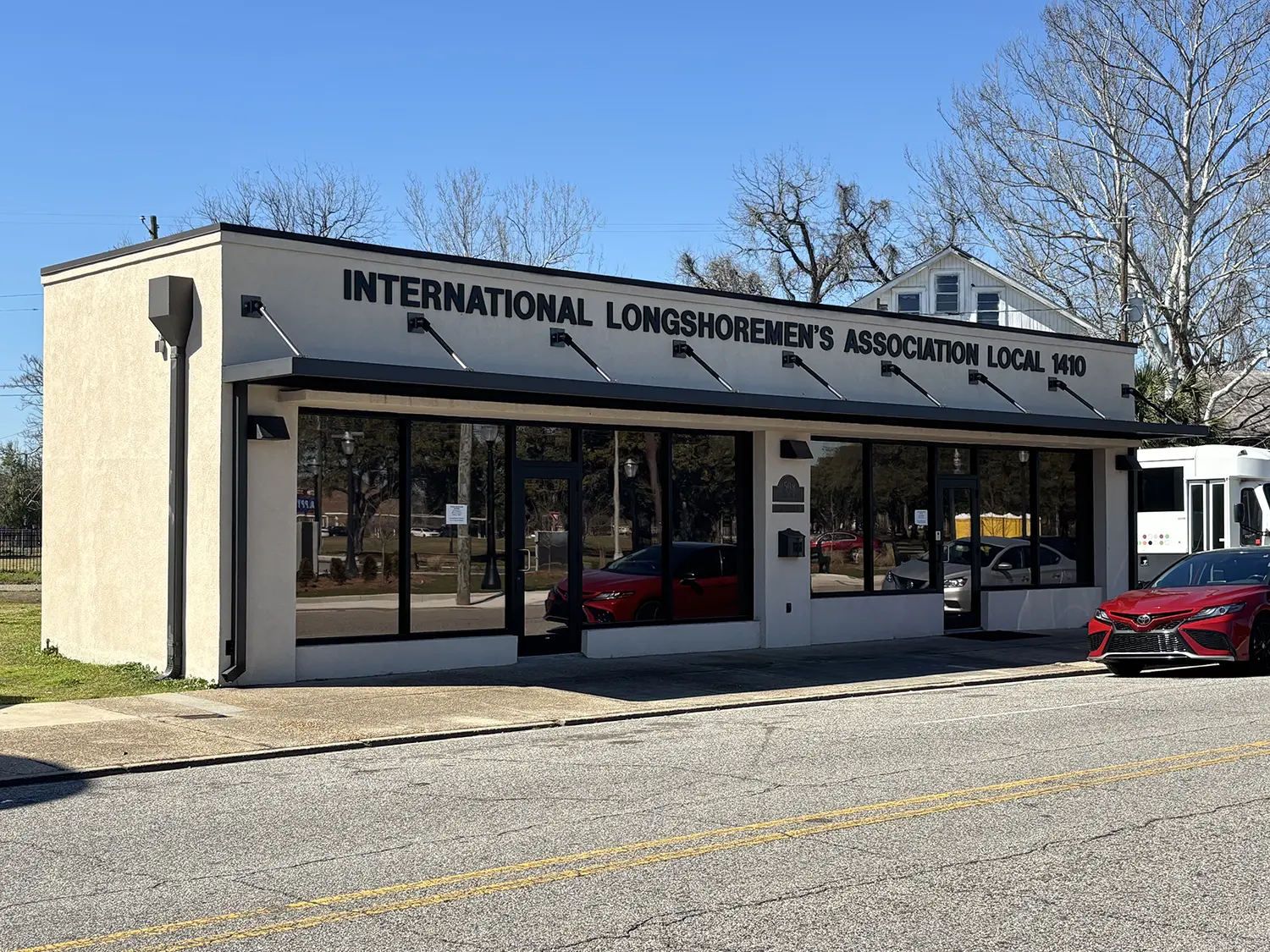
Not only was it the meeting place for many civil rights activists, but the ILA Hall also served as a vital center for cultural life in Mobile’s Black community. At a time when segregation limited access to public venues, the Hall provided a rare space where African Americans could gather freely, celebrate their culture, and share collective experiences. Nationally known performers such as Elvis Presley and James Brown took the stage there, alongside other hugely popular Black entertainers of the 1950s and 1960s. These performances were more than concerts; they were moments of visibility, pride, and shared identity during an era of widespread exclusion. For many in attendance, the Hall was one of the few places where Black excellence, joy, and creativity could be openly expressed without restriction.
In 1949, the ILA Hall was built at 505 Dr. Martin Luther King Jr. Avenue, then known as Davis Avenue, the commercial and cultural heart of Black Mobile and a local hub of Black-owned businesses, churches, and professional services. Constructed at a cost of $1 million, the building stood as a significant investment in both labor and community infrastructure. Its scale and permanence symbolized stability, self-determination, and collective strength during a time when many African American institutions were underfunded or deliberately undermined. For members of the International Longshoremen’s Association, particularly Local 1410, the Hall was a place of organization, protection, and solidarity. For the broader community, it quickly became a trusted gathering space—one where ideas were exchanged, plans were formed, and voices that were often marginalized elsewhere could be heard.
Some of the most historic meetings in Mobile’s civil rights history were held within the walls of the ILA Hall. Labor leaders, ministers, organizers, and everyday citizens met there to discuss voting rights, workplace conditions, segregation, and strategies for peaceful protest. These meetings were often practical and strategic, focusing on how to navigate local laws, protect workers, and advance civil rights without inviting violent retaliation. The Hall functioned as a bridge between labor activism and the civil rights movement, reflecting the reality that economic justice and racial justice were deeply connected. Longshoremen, whose work sustained the port and the city’s economy, understood firsthand the imbalance between the labor they provided and the rights they were denied.
On January 1, 1959, Dr. Martin Luther King Jr. made his only appearance in Mobile at the International Longshoremen Office Hall, marking one of the most significant moments in the site’s history. Speaking to a packed crowd, Dr. King addressed the ongoing struggle against segregation and emphasized the moral foundation of the movement. He preached a message centered on nonviolence, non-bitterness, and love, urging listeners to remain steadfast without surrendering their humanity. His presence validated the importance of Mobile’s local efforts and connected them to the broader national movement.
During his address, he told those gathered that “the old order of segregation is passing away and a new order of freedom is just coming into being.” His words resonated deeply with the audience, many of whom were living daily with the realities of segregation while actively working to dismantle it. The speech reinforced the Hall’s role not just as a physical space, but as a place where hope, resolve, and collective purpose converged.
Over time, the ILA Hall became emblematic of Mobile’s broader civil rights story—a place where culture, labor, and activism intersected. It stands as a reminder that progress was built not only through marches and courtrooms, but also through meetings, music, open thought, conversation, and community spaces that nurtured resistance and resilience. Today, the legacy of the ILA Hall endures as a testament to the workers of Local 1410 and to the people who gathered there, organized there, and helped shape the path toward greater equality in Mobile.