The Isom Clemon Civil Rights Memorial Park is the beacon on The Avenue. It speaks of so much promise that it held for so many people, and here it is, still holding our community together. We just have forgotten parts of the history. The park holds those stories and oral histories.
After years of collaborative planning and effort, representatives from the City of Mobile, Mobile County, local nonprofits, and the Clemon family dedicated the Isom Clemon Civil Rights Memorial Park in downtown Mobile on January 29, 2025.
This park was strategically placed directly across from the International Longshoremen’s Association (ILA) – a key meeting place in Mobile during the Civil Rights era and an organization Clemon led for years.
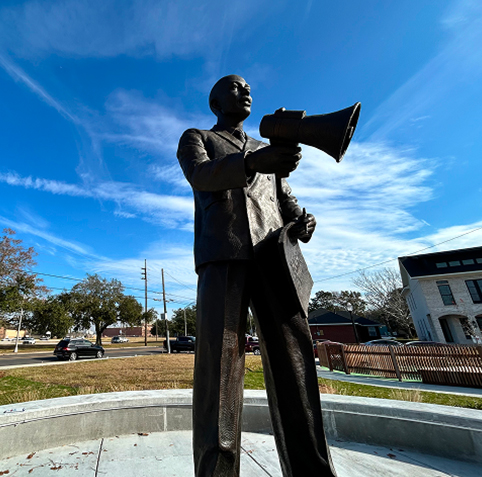
The park features multiple public art installations, including: an 8-foot-9 inch bronze statue, and educational relief plaques, honoring Isom Clemon’s contributions to African American labor in Mobile and his pivotal role in the local Civil Rights movement. The statue was created by Steven Whyte Sculpture Studios, following a nationwide contest overseen by the Mobile Arts Council.
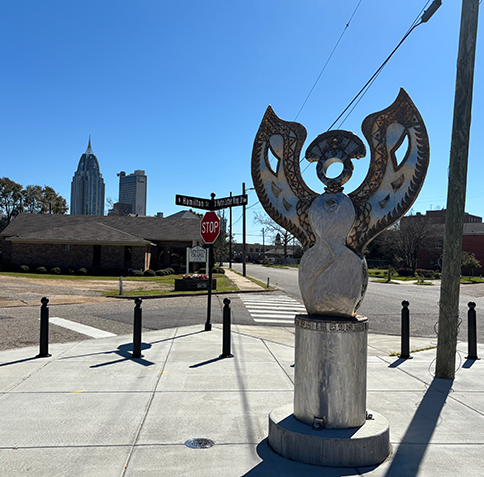
This stainless steel sculpture, created by local artists Charles Smith and Frank Ledbetter, commemorates the men and women of ILA Local 1410. Inspired by African textiles and symbols, it represents the efforts of ILA members to be respected for their labor, to achieve true liberty, and to share their love of life with all people. It was commissioned by the Rotary Club of Mobile and Main Street Mobile.
More than $1.4 million has been invested into the park through a collaborative effort between the City of Mobile, the Mobile County Commission, the Downtown Mobile Alliance and the Rotary Club of Mobile. Since 2016, local officials have worked with the Clemon family, ILA Local 1410, and various community stakeholders to create this “pocket park” together.
Today, Isom Clemon Civil Rights Memorial Park features improved seating, new sidewalks, enhanced landscaping, new lighting, and a unique play area designed with input from children at nearby Florence Howard Elementary School.
 The Power of Collective Bargaining
 A Place of Empowerment
 Great Leadership
 The March Continues
 Who Shall Restore the Breach?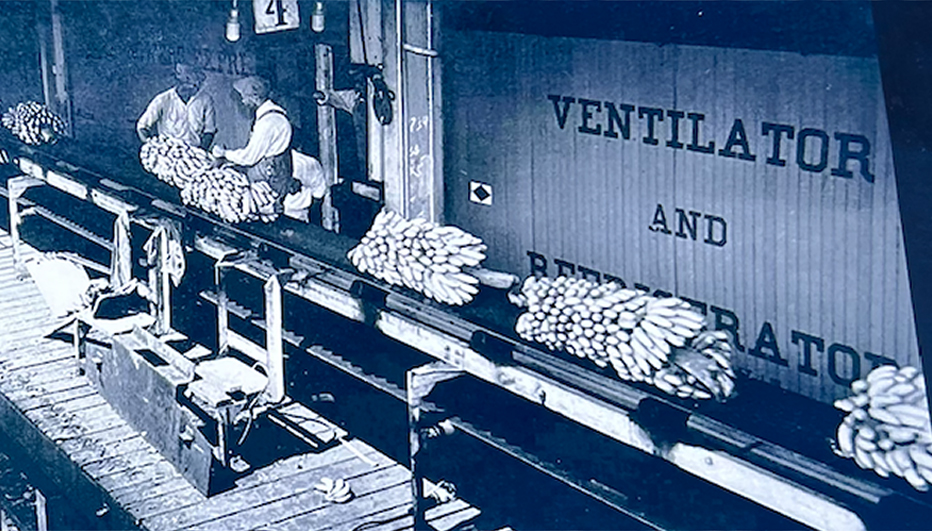
At the turn of the 20th century, as major industries grew, so did the inequities between the value created by workers and their actual quality of life.
Workers in many industries began to organize and form unions: voluntary democratic systems to collectively advocate for their rights. Through their union, workers gained the ability to negotiate from a position of strength with employers over wages, benefits, workplace health and safety, job training, and other work-related issues.
The spaces that were created for workers to come together on shared issues also served as a venue for larger issues of inequity that affected the entire community.
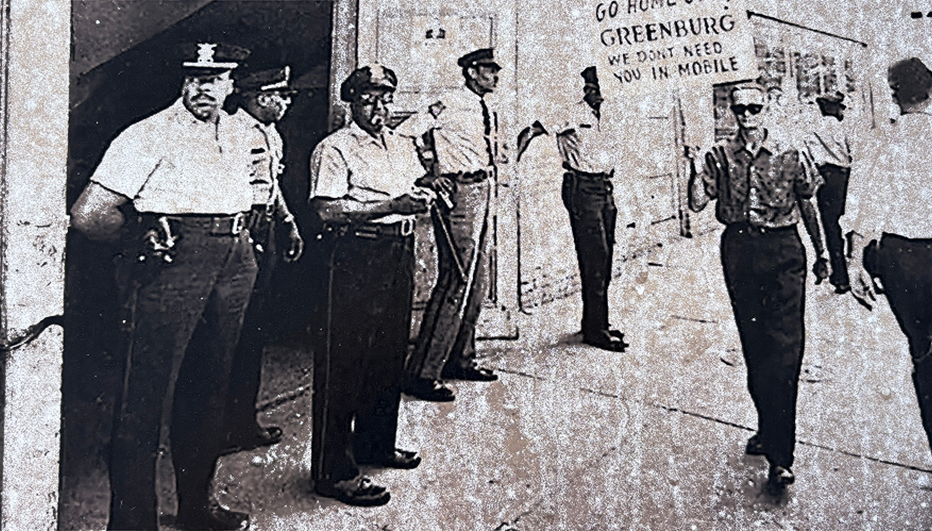
The Local 1410 Union Hall was the hub of not only longshoremen labor, but also Black empowerment. In the 1940s and 50s, 80% of the African American community had a family member working at the Alabama State Docks.
Despite the difficult, everyday conditions of the Jim Crow South, the collective bargaining power of unions granted Black families the ability to gain financial independence.
The Union Hall is one of the few remaining anchors of Davis Avenue, renamed Dr. Martin Luther King Jr. Avenue in 1986, which was the center of business, shopping, socializing and entertainment for the Black community. Workers gathered here to share stories and also resources that helped lift up the entire community.
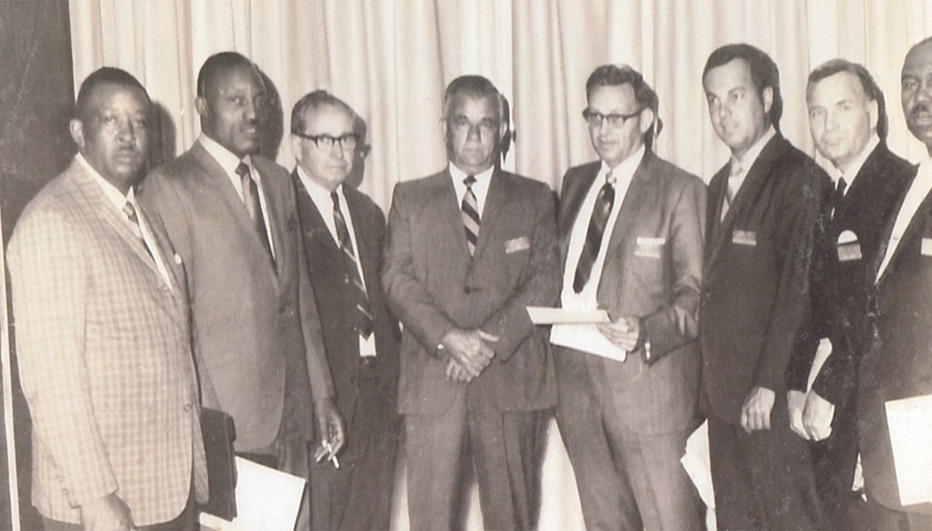
Isom Clemon served as President of the ILA Local 1410 during the height of the Civil Rights Movement. Clemon fought steadily to address specific workers issues. He fought to increase pension and welfare benefits, as well as to address political representation and advocated for civil rights for the greater community. He was a founding member of the Black Political Caucus of Alabama, later re-named the Alabama Democratic Caucus (ADC) in 1960.
Through his work, Clemon was instrumental in winning voting rights for Black citizens of Alabama. In the 21st century, Black voters constitute a majority in the State party and Alabama has seated more Black delegates per capita at the National Democratic Convention than any other state.
Isom Clemon’s lifetime of work within the ILA Local 1410 reminds us of the power of organized labor. His lifelong commitment to the power of the Vote, and to people of this community serve as an inspiration for restoration, reclamation, and revitalization of this historic American landscape.

In the decade of turmoil following the assassination of President Kennedy in 1963 and Martin Luther King, Jr. in 1968, racial tensions were high in Mobile. The issues raised by the Civil Rights Movement in the 1960s were still largely unresolved. Powerful and long-standing local organizations rose to meet those challenges. The rights of African Americans have been vigorously and successfully defended and expanded throughout the 20th century by Alabamians and the success continues to this day.
In December 2023, the U.S. Supreme Court ruled on the case Allen v. Milligan affirming that the State of Alabama in failing to create a federal court-ordered second majority African American Congressional district was in violation of the Voting Rights Act of 1965 and the 14th Amendment to the Constitution. District 2 which connects majority African American voters from Mobile across South Alabama with Montgomery was created.
From 1911 until 1985, Mobile, Alabama had a three person, at-large commission form of government that functioned to deny Black Mobilians political representation. The landmark Supreme Court Case, Bolden v. City of Mobile, first argued in 1979, asserted that this form of government violated the 14th and 15th Amendments to the Constitution. The Court initially held that the City was not in violation. The decision was only overturned after a 1909 “smoking gun” letter was discovered that revealed the racist intent of the Commission form of government.
In 1985, Mobile’s state legislators proposed a mayor-council form of government for the City, consisting of seven members to be elected from single-member districts, with the mayor to be elected at-large. The three African Americans elected to the council that fall became the first Blacks to hold city office since Reconstruction. Even so, the lack of political representation during the 1960s and 70s resulted in Urban Renewal practices that erased and devalued this important neighborhood.